

Know Thy Enemy
A Converging Vision of Power Threatening Democratic Pluralism

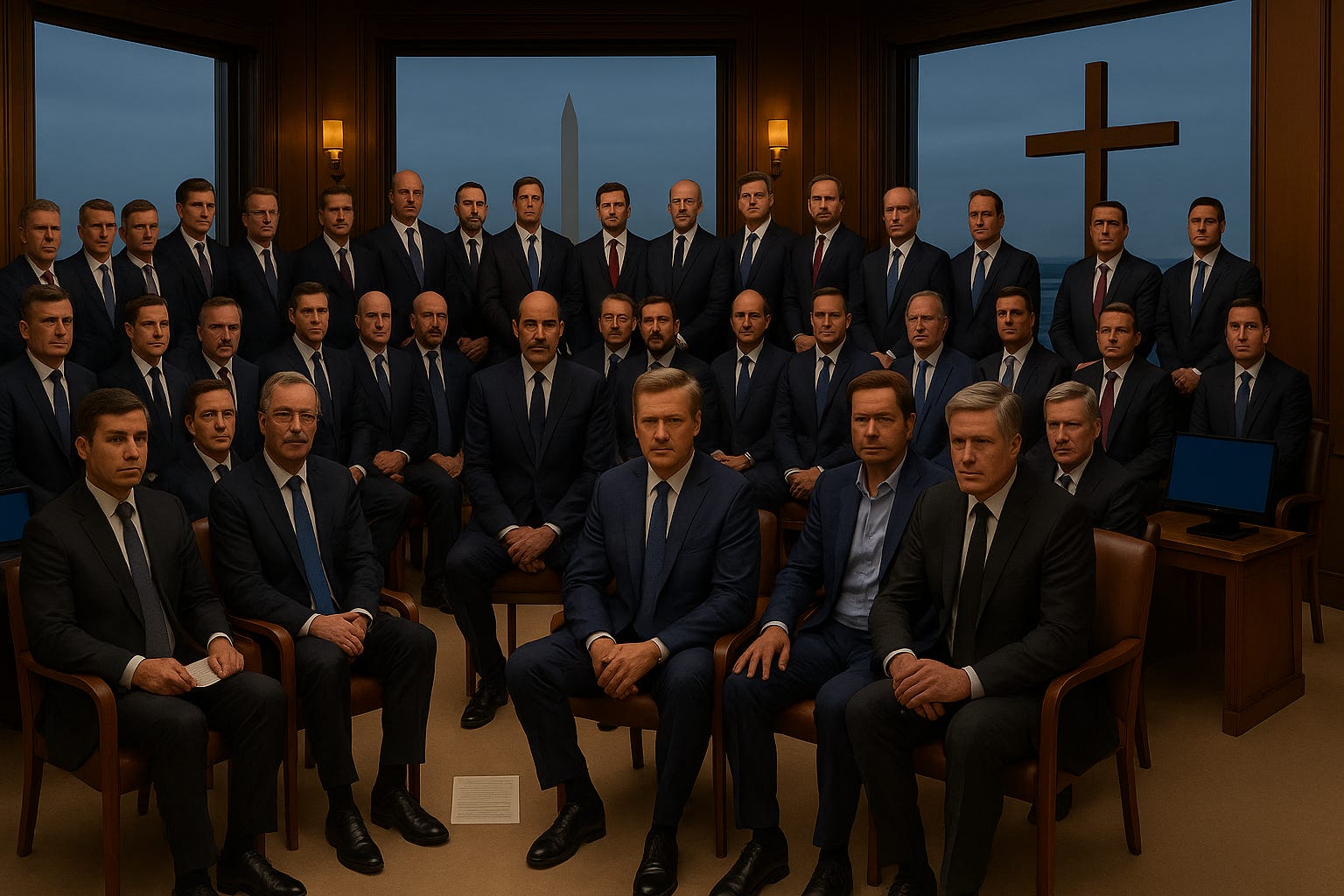
Author Note: My husband called this piece a departure, and he’s not wrong. I’ve always dug into data to expose what’s breaking us—politics, media, trust—and I’ve often slipped in humor to make the weight of it a little lighter.
But the hour is late. That heaviness we all feel is real. The grip of the news cycle is unrelenting. I’ve spent the last 36 hours—head cold and all—watching Simon Cowell and talent shows, trying to let the outside world fade—no social media. No commercials. Nothing.
And yet, like a ghost whisper, the words of Project 2025 keep echoing. The list of contributors and writers proves it’s more than church literature. It’s a blueprint for what the Far Right wants this country to become. With my technology background, I recognize the personalities pushing an agenda of technocracy. The same mentality once ran the cubicle hell of technical support before outsourcing, now scaled to the nation itself.
We are entering a period reminiscent of the 1760s before the Revolutionary War, or the 1850s before the Civil War. We’re on the edge of chaos. This isn’t just another breakdown; it’s a demand to act—because division and power grabs now require more than observation. I’ll continue to write my regular articles and stick to my established formats. But there will be more of these, too.
This piece is a call to prepare and stand together. We can’t just watch history unfold—we have to shape it. We must prepare, and we must fight for what’s ours. Waiting for collapse is no longer an option.
This is my line in the sand.
As of September 2025, a profound shift is underway in the American political landscape. With Donald Trump’s second term in office and initial elements of Project 2025 already being enacted through executive orders—such as agency purges and deregulation initiatives—the convergence of conservative think tanks, influential tech billionaires, and the Evangelical Right has solidified into a formidable coalition. This alliance, operating primarily through the Republican Party, seeks to reshape the United States’ governance, economy, and cultural fabric.
What began as contrasting ideological strands has merged into a unified strategy for long-term power consolidation. To prepare for what comes next, we must trace each strand back to its roots, follow how it has fused with the others, and confront the tensions holding them together. That clarity is not optional—it is survival.
“If you know the enemy and know yourself, you need not fear the result of a hundred battles. If you know yourself but not the enemy, for every victory gained you will also suffer a defeat.”
— Sun Tzu - The Art of War
Our survival depends on reversing that equation. That begins with unflinching knowledge—of ourselves and of the adversaries we now face.
The Blueprint for Structural Overhaul
Heritage Foundation
On January 20, 2025, one of Trump’s first acts was signing Executive Order 14171, which reestablished and expanded Schedule F. Since then, approximately 50,000 federal employees have been targeted for reclassification, making them easier to sideline or fire outright, with broader workforce reductions affecting over 200,000 employees through related policies. Early implementations have already zeroed in on perceived “deep state” elements, with loyalty tests reportedly conducted within agencies such as the FBI and EPA. Central to the broader strategy is the use of Schedule F as a purge mechanism, stripping career officials of civil service protections and consolidating power in the executive branch.
Key architects include Heritage Foundation president Kevin Roberts, who has described the project as nothing less than a “second American Revolution,” and Russ Vought, who served as Trump’s budget director in his first administration and now again leads the Office of Management and Budget, openly calling for “institutionalizing Trumpism.” Their blueprint spans nearly 900 pages, outlining reforms across almost every federal agency—from the Department of Justice to the Environmental Protection Agency.
Heritage is not alone in this effort. Alongside its policy blueprints, the Federalist Society has provided the judiciary as the enforcement arm. For decades, it has cultivated judges, clerks, and legal scholars, ensuring that when Trump needed Supreme Court nominees, a list was already in place. The result was rulings like the 2022 reversal of Roe v. Wade, which aligned seamlessly with the coalition’s long-term goals. In 2025, Project 2025 counts on this judiciary to rubber-stamp executive overreach, shield deregulation, and dismantle the administrative state.
But the overhaul extends beyond personnel or case law. Project 2025 encompasses sweeping cultural and legal agendas: banning gender-affirming care, restricting abortion nationwide, dismantling diversity and inclusion programs, and centralizing authority in the presidency by curtailing independent agencies. Its defenders frame these moves as a correction to the “liberal administrative state” that emerged from the New Deal. Critics—including some former Republican officials—warn that it is less about efficiency and more about establishing a permanent ideological regime, one that future administrations could not reverse without constitutional amendments or the wholesale dismantling of the government itself.
To execute this vision, the Heritage network has built a database of over 20,000 pre-vetted candidates, recruited through conservative networks and online portals. This “plug-and-play” system ensures rapid deployment, now that Republicans hold power in 2025. By invoking legal theories like the “unitary executive,” it claims justification for concentrating unprecedented authority in the presidency. In practice, Project 2025 is not just a policy plan. It is a capture mechanism—an engineered system to take over the state apparatus, purge dissent, and fuse executive power with ideological purity.
Architects of a Parallel Corporate State
Tech Billionaires
Parallel to Project 2025’s institutional focus runs the influence of a select group of tech billionaires, whose visions blend libertarian ideals with authoritarian execution. Prominent figures include Elon Musk, founder of Tesla and SpaceX, who initially led the Department of Government Efficiency (DOGE) in the Trump administration; Peter Thiel, co-founder of PayPal and Palantir Technologies; and Marc Andreessen, a venture capitalist known for his “techno-optimist” manifesto. These individuals control vast swaths of information, communication, and defense infrastructure, positioning them as de facto power brokers.
Historically, Silicon Valley’s growth was fueled by government contracts, particularly from the Pentagon during the Cold War. Thiel’s Palantir, for instance, originated as a counterterrorism surveillance tool following the 9/11 attacks, evolving into a key player in data analytics for immigration enforcement and military operations. Musk’s acquisitions, including X (formerly Twitter) in 2022 and the expansion of Starlink satellites, demonstrate how private entities can influence global connectivity, as evident in Musk’s decisions to provide or withhold Starlink access during conflicts, such as the war in Ukraine. Andreessen’s investments in defense startups further tie tech capital to national security.
These billionaires advocate for deregulation, the privatization of public services, and minimal government intervention in markets, framing themselves as innovators who disrupt outdated systems. Yet their actions reveal a preference for corporate dominance, as evidenced by their opposition to antitrust laws, unionization efforts, and public oversight of platforms. Musk’s X has been criticized for amplifying far-right content through algorithmic changes, while Thiel’s funding of politicians like J.D. Vance (now Vice President) ensures alignment with GOP priorities. In 2025, their involvement in DOGE focuses on reducing federal spending and outsourcing functions to private firms, aligning seamlessly with Project 2025’s goals of weakening regulatory bodies such as the FTC and SEC.
This faction’s “parallel state” narrative—building tech alternatives to government—masks a deeper integration with state power. Their wealth, exceeding trillions in collective market value, funds think tanks, political action committees, and media outlets, reinforcing a worldview in which economic freedom is equated with unchecked corporate authority.
As of 2025, their priorities—tax cuts for the ultra-wealthy, reduced labor protections, and privatization of space and AI—dovetail with Project 2025, creating a symbiotic relationship where tech infrastructure supports ideological enforcement.
Moral Backbone and Mobilization Force
Evangelical Right
The Evangelical Right forms the third element, evolving from a fragmented religious movement into a highly organized political entity. Its origins date back to the 1970s, with Jerry Falwell’s Moral Majority, which mobilized white evangelicals around issues such as abortion and family values, and Pat Robertson’s Christian Coalition in the 1990s, which professionalized voter turnout efforts. By the 2000s, organizations like Focus on the Family (led by James Dobson) and megachurches pastored by figures like Rick Warren had embedded evangelical priorities into the Republican platform.
Trump’s first term marked a pinnacle: despite his personal scandals, he secured evangelical support by appointing three Supreme Court justices who, in 2022, overturned Roe v. Wade. In 2025, this influence persists through groups like the Council for National Policy, a secretive network connecting religious leaders, donors, and politicians. Evangelicals advocate for a “biblical worldview” in governance, including bans on same-sex marriage recognition, restrictions on transgender rights, and integration of Christian teachings in public education.
Their strategy involves grassroots infiltration: controlling school boards, state legislatures, and judicial nominations. This provides the moral rhetoric and voter base that Project 2025 and tech billionaires lack. For instance, evangelical-backed laws in states like Texas and Florida mirror Project 2025’s anti-LGBTQ and anti-abortion mandates, while their media empires—outlets like the Christian Broadcasting Network—amplify narratives of cultural decay requiring divine intervention. In the current administration, evangelical advisors shape policies on family separation at borders and religious exemptions in healthcare, framing opposition as moral deviance.
Convergence Under the Republican Party
The Heritage Foundation’s Project 2025, a handful of powerful tech billionaires, and the Evangelical Right have converged into a coalition that subordinates democratic institutions to a rigid, hierarchical order. Each faction fills gaps the others cannot: the Heritage Foundation supplies the policy blueprints and legal scaffolding, billionaires contribute money, technology, and global reach, and evangelicals deliver mass mobilization and ideological justification.
What began as separate movements—think tanks, corporate networks, and religious crusades—has fused into a power bloc with the Republican Party as its indispensable vessel.
This convergence manifests in shared targets: dismantling environmental regulations to serve the interests of billionaires, enforcing cultural conservatism to satisfy evangelical priorities, advancing hyper-racism as a binding ideology, and centralizing executive power to realize Heritage’s designs. In 2025, the results are already visible: Musk’s Department of Government Efficiency (DOGE) advancing deregulation, evangelical-backed policies filtering through bureaucracies packed with loyalists, and Heritage-trained operatives embedding themselves across agencies.
The GOP’s evolution makes this merger possible. Ronald Reagan’s 1981 declaration that “government is not the solution to our problem; government is the problem” once anchored a small-government creed of deregulation, tax cuts, and limited federal intervention. By 2025, that rhetoric persists as window dressing, but its meaning has been repurposed. “Small government” now means a centralized executive state outsourced to private capital and religious doctrine.
Within this framework, each group secures what it needs. The Heritage Foundation gains grassroots legitimacy and billionaire cash. Tech magnates secure protection for their business empires while advocating for deregulation and privatization. Evangelicals harness party machinery to impose their theocratic agenda. Their mutual dependence makes the GOP their shared instrument, and Donald Trump their unifying figure—his tax cuts, judicial appointments, and grievance politics binding the coalition into one.
Frictions Within the Coalition
While the Heritage Foundation’s Project 2025, tech billionaires, and the Evangelical Right have coalesced under the Republican Party to pursue a shared vision of power, their partnership carries undercurrents of divergence. Each brings its own priorities and methods, which do not always align perfectly.
Ideological Misalignments: Libertarianism vs. Theocratic Control
Tech billionaires champion libertarian principles, while evangelicals seek theocratic restrictions, clashing over issues like censorship or reproductive rights. For instance, evangelicals’ pushes for pornography bans conflict with Musk’s free speech stance on X, and Thiel’s surveillance tools may alarm evangelicals wary of state overreach.
Strategic Priorities: Structural Capture vs. Corporate Autonomy
The Heritage Foundation’s centralized state model contrasts with the billionaires’ push for corporate dominance. While DOGE’s agency cuts align with deregulation, resistance may arise if the Heritage Foundation imposes ideological regulations on tech firms. Tensions over state versus corporate control could fracture policy alignment, particularly as billionaires prioritize profit-driven autonomy.
Cultural and Class Divide: Elitism vs. Populism
Billionaires’ cosmopolitan elitism clashes with evangelicals’ populist, America-first base. Musk’s global ventures, such as Starlink, contrast with evangelical isolationism, and Thiel’s intellectualism alienates heartland voters. This divide risks weakening grassroots support if evangelicals distrust billionaire motives, especially given Musk’s controversial X posts or Tesla’s labor disputes.
Methods of Influence: Top-Down vs. Bottom-Up
The Heritage Foundation and billionaires favor elite strategies, while evangelicals rely on grassroots activism. X’s algorithmic control contrasts with evangelical radio, and the Heritage Foundation’s bureaucracy may sideline local efforts, such as school board wins in Florida (2022–2024). Differing tactics could lead to inefficiencies or sidelined efforts, as seen in 2025 debates over prioritizing economic versus social mandates.
Long-Term Vision: Secular Futurism vs. Religious Eschatology
Billionaires’ tech-driven futurism (e.g., Musk’s Neuralink, space colonization) conflicts with evangelicals’ biblical focus on end times. Evangelical warnings against “godless tech utopias” in 2023 highlight tensions, as do debates over AI governance versus the restoration of earthly values. These divergent goals could destabilize long-term planning if not reconciled.
Managing Friction Within the Coalition
Despite tensions, the coalition maintains unity through mutual dependence and shared enemies (e.g., liberal institutions). The Heritage Foundation mediates by aligning evangelical moralism with billionaire economics under a GOP framework. Trump’s leadership bridges divides, satisfying all sides with policy wins like judicial appointments and tax cuts. However, signs of strain in 2025 include:
– Public spats on social media between evangelical and tech-aligned GOP figures over social policy priorities.
– The Heritage Foundation’s recruitment favors evangelicals over tech-backed candidates.
– Moderate Republicans, like Rep. Brian Fitzpatrick, are exploiting divides to resist the coalition’s extremism.
These fault lines provide opportunities for opponents to weaken the coalition by amplifying internal contradictions. For instance, highlighting evangelical censorship demands could alienate libertarian-leaning tech supporters, while emphasizing billionaire elitism might erode evangelical grassroots support.
Pushing Back Against the Coalition
If this all feels overwhelming, that’s the point—it’s designed to be. But don’t confuse complexity with inevitability. There are fractures within this coalition, and ordinary people can pry them open if they know where to apply pressure. This isn’t about playing their game—it’s about exposing the hypocrisy, amplifying the contradictions, and making it impossible for billionaires and the Evangelical Right to keep pretending they’re on the same page.
Exploit Their Fault Lines
The billionaires preach libertarian freedom, the evangelicals demand moral obedience. Those two visions are not compatible. Highlight it. Please share it. Write it. When Musk shouts “free speech absolutism” while evangelicals ban books, the contradiction writes itself. Compare the stories of students losing access to libraries and parents fighting curriculum bans with those of billionaire platforms claiming to defend free expression. Flood the zone with side-by-side evidence and force the question:
Whose speech really gets protected here?
Use Their Scandals Against Them
The Epstein files, the steady drip of elite corruption, and the hypocrisy of “family values” posturing are not fringe curiosities—they are blunt instruments. Treat them that way. Push verified documents into public view, back independent reporting with money and amplification, and insist on receipts: timelines, source citations, scanned records. The point is not to smear without proof; it’s to make the arithmetic clear: preach purity, take dirty money, and your moral authority evaporates. When Republican gatherings crash Grindr faster than a televangelist’s sermon on “traditional marriage,” the irony writes its own viral headline.
Let’s say their app crashes speak louder than their pulpit promises.
Talk Directly to Libertarians
Don’t argue with hardened theocrats—you won’t win. But libertarians, disillusioned tech workers, and younger voters with a “leave me alone” streak? They’re reachable. Remind them that evangelical policies don’t stop at sermons—they invade bedrooms, browser histories, and private medical choices. Use their own language: liberty, privacy, autonomy.
Push it through podcasts, Substacks, Reddit forums—everywhere the “don’t tread on me” crowd gathers—share to multiple places, and not just in your Democratic bubble.
Push Back on Centralization
The Heritage playbook is about executive overreach. That doesn’t just threaten progressives—it threatens every industry billionaire donors care about. Make it plain: if Schedule F purges succeed, the same machinery could someday target them. Support antitrust fights, amplify regulatory pushback, and call out how moral crusaders can weaponize data tools. Ask out loud:
Do you really trust them with the keys to your privacy?
Match Their Organizing with Our Own
Evangelicals built their power locally, in school boards, town halls, and church basements. That can be mirrored and outflanked. Run candidates on defending the right to read books, teach history, and keep personal freedom intact—host town halls about surveillance creep and censorship. Fund small outlets that can tell these stories without billionaire filters. Build coalitions not just around parties, but around issues that resonate across the spectrum—such as freedom, fairness, and transparency.
Follow the Money
Trace the donations. Map the ties. Every billionaire check cut to an evangelical PAC should be dragged into the light. Share the graphs, the receipts, the web of connections. Nothing dissolves “family values” posturing faster than a straight line from billionaires’ wallets to theocrats’ pulpits. Expose the pipelines that move dark money from corporate boardrooms into local politics, and you’ll see just how quickly the mask of moral crusade slips. Once people see the same donor bankroll both deregulation and dogma, the myth of principle collapses.
Always show the receipts; truth with proof makes a difference.
To get you started, click on the logo below and begin your search through election donations:

If you ever encounter this link is broken or access is denied, please let me know.
Disaffected Republicans and Swing Voters
The “Republican” Party of today is not the historical party it once was. It is not even the party of Reagan. In its transformation into a vehicle for authoritarian projects, it has created a new bloc of disaffected voters—longtime Republicans and swing voters who no longer recognize the party they once supported. Traditionally, Republicans have been consistent down-ballot voters, anchoring local, state, and federal races with predictable turnout.
Now, cracks are showing. Figures like Liz Cheney and Adam Kinzinger embody this estrangement, while suburban moderates in swing districts have peeled away in protest. Some feel politically homeless, estranged from a party that elevates grievance and control over the principles of limited government and personal freedom that once defined it.
Young voters are unwilling to compromise by choosing the lesser of two evils, leading many of them not to vote. This genuine sentiment must be addressed through education to highlight the risks of disengaging from the electoral process.
These voters represent a vulnerable flank in the coalition, and their unease exposes the costs of the GOP’s radical consolidation.
Breaking the Illusion of Unity
This isn’t abstract resistance — it’s practical, visible, and lawful protest, politics, and persuasion. Drag their money into the light, highlight the hypocrisy in their speeches, peel away the local power structures they depend on, and win back the places where real power is made.
The alliance of the Heritage Foundation’s Project 2025, tech billionaires, and the Evangelical Right represents a deliberate effort to consolidate power, reshaping America’s democratic institutions into a hierarchical order. Their convergence under the Republican Party leverages policy, wealth, technology, and moral rhetoric to entrench ideological control.
Yet frictions—ideological, strategic, cultural, methodological, and visionary—offer fault lines for opponents to exploit.
The test of 2025 isn’t whether the coalition remains unified—it’s whether the rest of us recognize the cracks, have the nerve to drive wedges into them, and refuse to let the illusion of unity harden into permanence.
👀 Watch widely. 📚 Read deeper. ✅ Fact-check your footnotes.
❤️ Tap → If this piece clarified just how dangerous Project 2025’s coalition is, give it a like–it helps the algorithm.
💬 Comment → Do you see echoes of this “blueprint” in your community or workplace? Share your thoughts below.
📣 Share → Send this to someone who still thinks Project 2025 is just “policy talk” and not a roadmap to authoritarian rule.
📬 Subscribe → For more investigative work tracking America’s drift toward technocracy and theocracy.
🌎 Our voices need to carry further. Restacking and sharing inside our circle of “close friends” isn’t enough. If we only preach to our own Democratic bubble, we’re going nowhere. We have to reach beyond — especially toward people in the middle who don’t know which way to turn. Talk with them. Share with them. Read with them. That’s how we start to reverse this mess.
References
Key Sources for Claims in the Piece
Author Note & Introduction (Historical Parallels, Project 2025 as Blueprint)
Heritage Foundation, Mandate for Leadership: The Conservative Promise (2023). Full text: heritage.org.
Anne Nelson, Shadow Network (2019; updated 2024). Context on coalition parallels to Civil War fractures.
Coverage of contributors beyond church literature: Federalist Society, tech-aligned groups (Heritage announcements, 2023–2025).
The Blueprint for Structural Overhaul (Heritage Foundation)
EO 14171 – Schedule F reinstatement: Federal Register, Jan. 20, 2025; White House Report Card, June 2025 (~41% implementation; ~50,000 reclassified).
Kevin Roberts, “Second American Revolution”: Interviews on War Room (2024) and Heritage events (2025); NYT and Politico coverage.
Russ Vought, “Institutionalizing Trumpism”: Confirmed OMB Director Feb. 2025 (Senate vote 53-47); testimony & 2024 hearings.
Federalist Society vetting of Trump’s SCOTUS justices → Dobbs (2022).
Mandate for Leadership: bans on gender care, abortion, DEI (pp. 400–500+); Politico 2025 EO tracker (37+ alignments).
Heritage personnel database (~20,000 by July 2024).
“Unitary Executive Theory” framing: PBS, Wikipedia summaries.
Architects of a Parallel Corporate State (Tech Billionaires)
DOGE (Dept. of Government Efficiency): EO signed Jan. 20, 2025; Musk as de facto head. Senate Warren report (2025) disputes $205B “savings.”
Palantir (Thiel): ICE ICM/FALCON use since 2013; $900M+ contracts post-2024; $30M ICE contract (2025).
Andreessen’s “Techno-Optimist Manifesto” (2023, a16z.com).
Musk’s 2022 Starlink shutdowns in Ukraine; 2025 disputes tied to mineral access.
Thiel’s $15M+ in Vance’s 2022 Senate run; mentorship role.
Axios & BBC tracking deregulation/privatization ties (2025).
Moral Backbone & Mobilization Force (Evangelical Right)
Jerry Falwell’s Moral Majority (1979); Reagan coalition.
Pat Robertson’s Christian Coalition (1989–1990s).
Trump’s SCOTUS appointments → Dobbs (2022).
Council for National Policy: founded 1981; Trump appearance 2020.
Grassroots strategy: control of 2,000+ school boards; TX/FL 2025 laws mirroring Project 2025.
Convergence Under the Republican Party
Heritage + tech + evangelical alignment (100+ partners). BBC/Axios track 2025 implementations (e.g., DOGE).
GOP evolution: Reagan “small gov” → 2025 centralization. Project 2025 as embodiment.
Frictions Within the Coalition
Libertarianism vs. theocracy: NYT/Meador (2025).
Structural capture vs. corporate autonomy: Global Counsel (2025).
Cultural/class divides: Vox (2025).
Top-down (Heritage/tech) vs. bottom-up (evangelical grassroots).
Secular futurism vs. religious eschatology: New Intermag (2025).
Strain signs: Politico (2025) infighting reports; Guardian moderates coverage.
Pushing Back Against the Coalition / Disaffected Republicans
Cheney & Kinzinger censured by RNC (2022); Kinzinger’s Country First.
Swing voter cracks/youth disengagement: Deseret News (2022–2025); Pew evangelical turnout data.
Respect this article ⬆️!!!
Thank you perfect summary of project 2025