

Join Substack as a Writer—Immediately Question All Your Life Choices
Substack has no cops. Just vibes, vegetables, and three cartons of Trump’s eggs!

People say, “just start a Substack!”
They say it like it’s easy. Like it’s a breezy next step for thoughtful people with something to say.
But they don’t tell you that choosing a publication name will trigger a midlife branding crisis. They don’t mention how you’ll go from picking fonts to spiraling into the ethics of serifs. They definitely don’t warn you that by day three, you’ll be sweating over your tagline like you’re naming your firstborn.
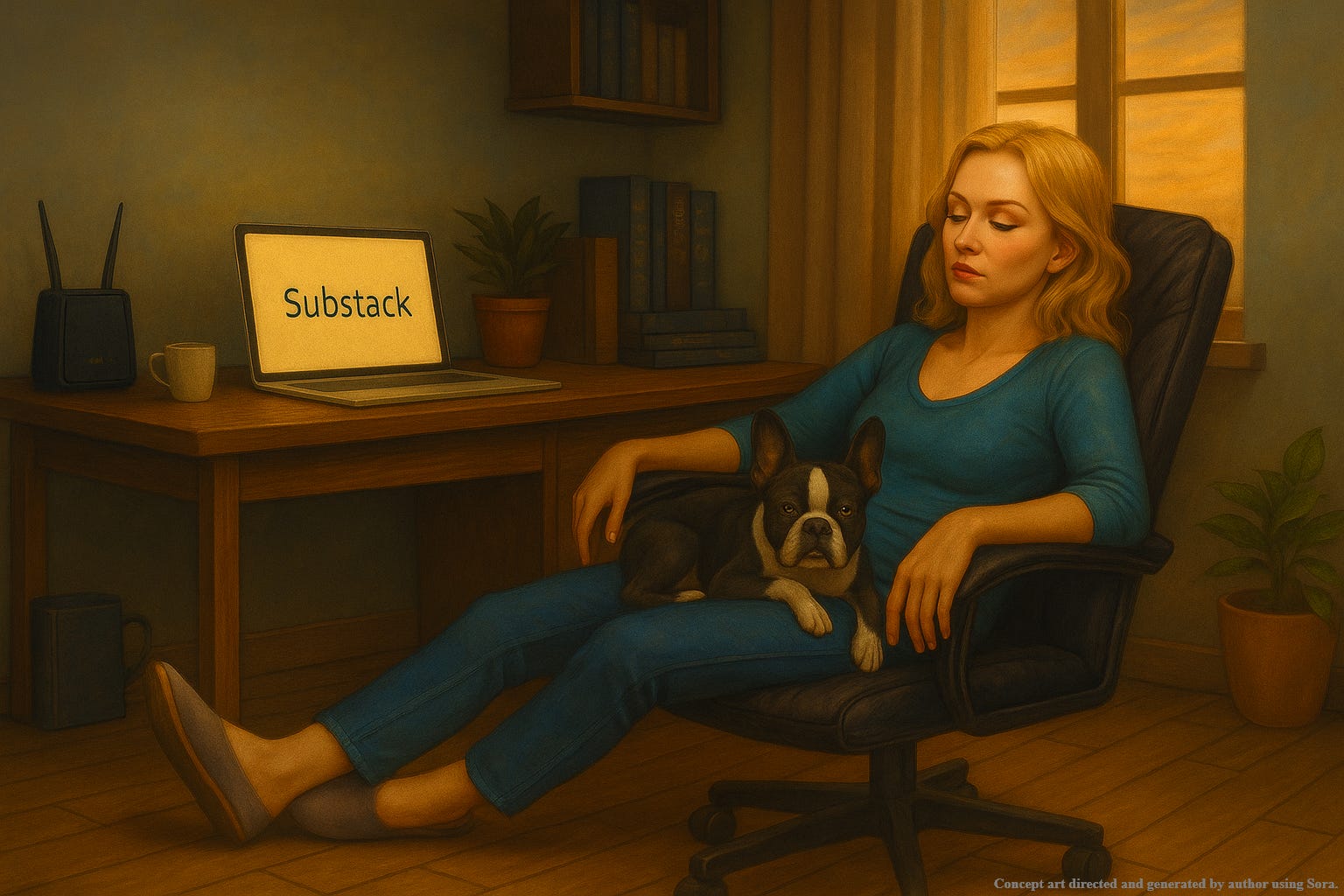
Phase One: Delusional Enthusiasm
“You should totally start a Substack!”
—Friends who have absolutely no intention of reading it
You’re brimming with takes. Insight. Maybe a little rage. You’ve got Something To Say™ and finally—finally!—a place to say it. You imagine essays so good they’ll be screenshot and texted out of context by people who wear glasses in their profile pics.
Fast-forward 30 minutes and you’re on your fifth title draft, second existential crisis, and wondering if “newslettering” is even a verb.
Phase Two: Setup Spiral (Where Good Intros Go to Die)
You change your newsletter name five times. You create graphics. Delete graphics. Recreate “better” graphics that somehow look worse. Your header image takes two hours. Your tagline takes three. Your focus shapeshifts weekly—from “media criticism” to “soft rage with footnotes.”
You rewrite your About page like it’s going on a dating app:
“I’m smart but not annoying, political but not alienating, personal but not oversharing. Please love me and subscribe.”
Phase Three: The Social Media March of Shame
This is when you have to… promote it.
Which means you suddenly remember you have eight social platforms, all cursed in their own way:
X (Twitter, but haunted)
Facebook (where your aunt calls it “brave”)
Threads (where no one sees anything, ever)
Instagram (you post a Canva teaser that takes 90 minutes and four breakdowns)
LinkedIn (you regret this instantly)
BlueSky (still feels like beta testing the apocalypse, but hey—vibes)
TikTok (because apparently now you need to be funny and hot and an editor)
Weibo (you’re not sure why you created this account, but it felt important at the time)
Don’t forget to add all your social media links to your Substack profile. You agonize over the order, the formatting, and whether your X handle makes you sound like a bot or a banned account.
It does. That’s fine.
Phase Four: The Dashboard of Delusion
You hit publish. It’s just past midnight. Fifteen edits deep. You made a whispered deal with the universe and pushed the button anyway.
You refresh your Dashboard: one view (that was you), one subscriber (also you), and one like—your partner, pretending they read it.
They didn’t, but they appreciate the hustle. Honestly, it’s more of a reminder that he’s already in bed and you’re still up too late.
You’ve got a share. That’s your recently college-graduated daughter, posting it to her private Discord server. You can hear the muted sounds of her laughing through the wall. It still counts. But you’re stunned she paused her late-night gaming long enough to actually read it.
You wonder if you followed all the grammar rules from eighth-grade Language Arts—the ones from The Little, Brown Book of Grammar. You make a mental note to order the newest edition—just to make sure you know what you’re doing.
You consider emailing yourself through the Substack system—just to make sure it’s working.
That’s normal. Right?
Eventually, somewhere between caffeine withdrawal and mild self-doubt, you close the laptop and crawl into bed.
☕ The Next Morning
It’s 8:12 a.m. You’re still on your first coffee.
You open your Dashboard.
You’ve got a new subscriber. It’s your mother-in-law.
You’ve got a like. It’s your partner again—a new way to say “I love you” from his office upstairs, without pausing whatever it is he’s actually doing up there.
You refresh again. Nothing changes.
And then… the phone rings.
It’s your mother-in-law. She never calls this early. But she read your entire post. She has questions—not criticisms, just that calm, curious inquiry that somehow feels like both love and a thesis defense. She wants to know how the economic metaphor in paragraph four connects to your tone strategy. She also wants to know if this “democracy-loving reader” business model is sustainable. And—gently, casually—she asks whether her adult grandchildren are being properly taken care of.
Are they eating enough vegetables?
She’s not mad. She’s engaged. She hums thoughtfully as you hear her scribbling notes—the kind that make you better. Almost offhand, she mentions she’s already shared the article with two friends and her sister. They’ve decided it needs further review. They’ll be discussing it at their next Mahjongg game.
You’ve been spun back into reality. You reheat your coffee. You refresh again.
You’ve got a new subscriber. Still your mother-in-law.
A comment. A reply. Another share. A reader who isn’t related to you. Someone who doesn’t share your DNA, your last name, or your Wi-Fi password. Someone who read your work and said, “Yes. This.”
Not ironically. Not because they’re related to you. Not even because they needed a new excuse to procrastinate. Just… yes.
You’re not just writing into the void anymore.
You’re building a signal.
You’re not just shouting.
You’re being heard.
Phase Five: The Paywall Panic
Sometime in the middle of the day—after so many refreshes Chrome starts to auto-sigh—you remember: there was something about getting paid.
You glance at the “Start Paid Subscription” button.
At first, you wonder: Did I accidentally click ‘Only Subscribers’? Is that why no one’s engaging?
You check. You didn’t. That’s not the reason.
You sigh. And for the first time since signing up, you actually read the Terms and Conditions. Sure, you glanced at them when you created the account—like a normal person. But now? You read them like they might bite.
And to your surprise? Substack doesn’t require Algebra II to get paid.
No spreadsheets. No calculator app. No “minimum ad payout threshold.” Just pick a number, link a Stripe account, and go.
You remember your last side hustle. The LuLaRoe incident. Let’s just say it ended with a negative balance, a hard stop from your upline, and an actual letter from the Washington State Attorney General’s office—the one that sued LuLaRoe. Turns out the leggings weren’t the only thing unraveling. You even got a refund check from the settlement. You were having fun… until you weren’t. You’re not falling for that again.
You fantasize about finally having income that doesn’t involve twelve browser tabs and emotional whiplash. You picture a cozy writing life funded by democracy-loving readers. You scroll past the “Start Paid Subscription” button like it's forbidden fruit—tempting, terrifying, possibly cursed. You start doing math you swore you’d never need outside of a Groupon checkout.
If ten people pay five bucks a month… that’s fifty dollars. Substack takes ten percent. Stripe takes a little more. That’s still… actual money.
That’s what—three cartons of Trump’s eggs?
That’s validation!
You pause.
That’s more than $0.38.
That’s almost Scalzi-adjacent.
And that’s when the panic kicks in.
Because what if your writing also requires a specialized mindset, like his readers? What if it’s not “clever,” it’s just “niche”? What if your readers need a decoder ring just to get through your second paragraph? What if no one gets your inside jokes—like that subtle reference to dial-up internet buried in a sentence about economic collapse?
You shake yourself out of the disillusionment fantasy.
It’s fine. You’re not Scalzi.
And that’s when the real depression kicks in—because if you’re not Scalzi, then your partner is definitely never going to read your work. Which means you’re shouting your strange, beautiful thoughts into the void like a caffeinated raccoon in a 2003 Wi-Fi router box.
Final Level: Acceptance (and Slight Obsession)
Let’s be honest. You’ve never had a problem saying something. You’ve said things in Facebook threads, in the grocery store parking lot, and once—memorably—at a school board meeting where the phrase “deep-fried nonsense” was used without apology.
This? This Substack thing? It’s not some dramatic new frontier.
It’s just a more organized version of what you were doing anyway. Only now there are font choices, footnotes, and people who actually came to hear you speak.
You settle into a rhythm. You change your niche again. You start adding footnotes to posts that don’t need them. You hoard draft titles like expired coupons. You check your email like it’s a stock ticker. You pretend the analytics page isn’t your new therapist.
It’s a grind.
It’s chaotic.
It’s yours.
And now?
You click the orange “New Post” button—
and you start the next article.
If This Made You Laugh, Nod, or Panic Slightly…
Go ahead—
💖 Tap the heart to show it hit the right nerve.
💬 Comment if you’ve been personally victimized by Canva.
📨 Subscribe if you’re into caffeine-fueled spiral essays with footnotes.
🔁 Share if you know someone else hovering over the “Start Paid Subscription” button like it’s cursed treasure.
It's free. Unless you want it not to be.
Which is also fine.