

DECREASE THE SURPLUS POPULATION
Cruelty Was Never the Side Effect. It Was Always the Plan

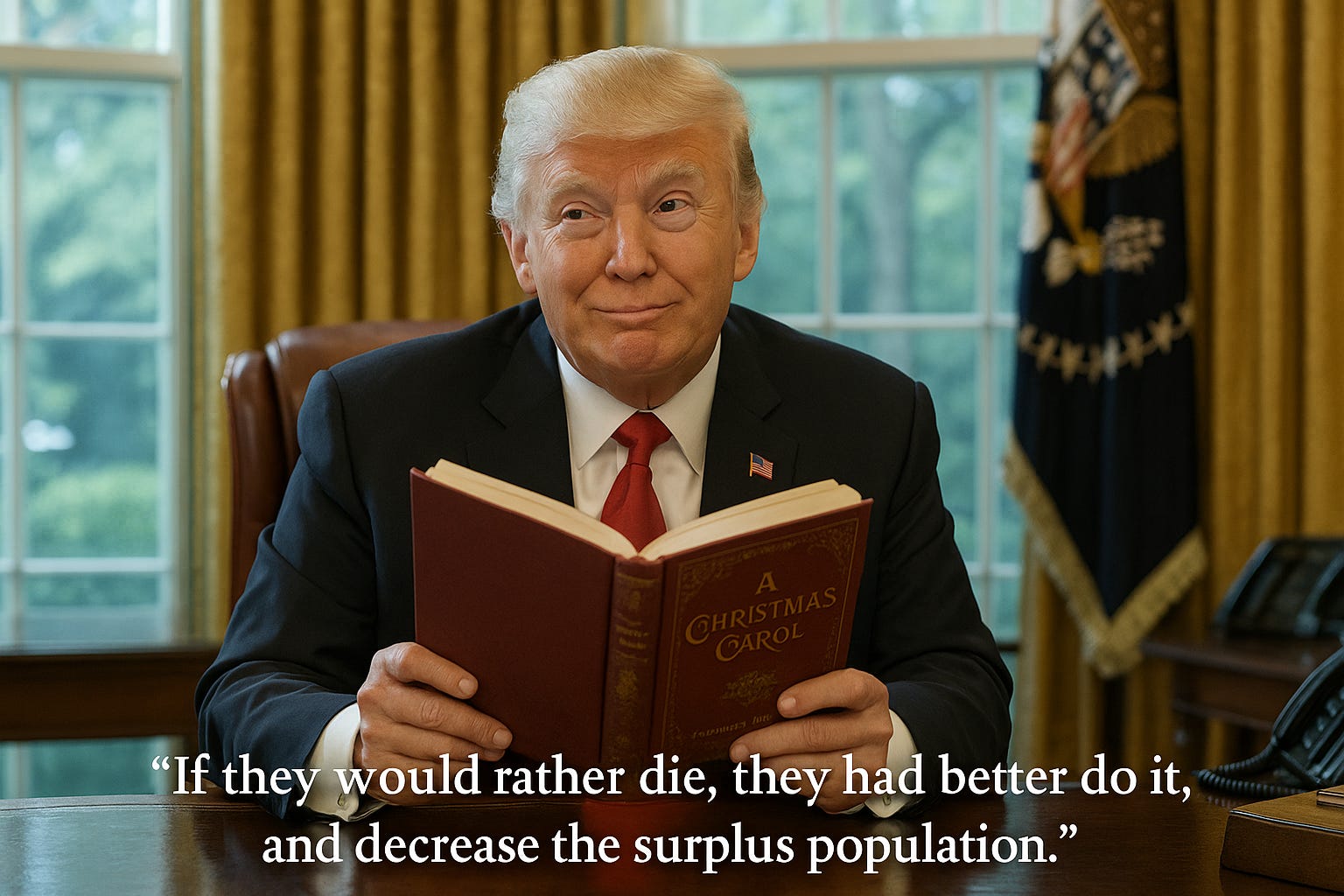
“If they would rather die, they had better do it, and decrease the surplus population.”
— Ebenezer Scrooge in Charles Dickens, A Christmas Carol (1843)
That was fiction. This is policy.
There was a time—imperfect but functional—when America at least pretended that protecting life was a bipartisan goal. Hospitals stayed open even if the zip code wasn’t profitable. Kids got breakfast at school. Medicaid covered families without question. We vaccinated entire towns in a weekend. No one debated whether insulin was a luxury.
It wasn’t utopia, but it wasn’t this.
Now, public services are being stripped to the bone. Rural ERs vanish. Food programs expire while grocery prices soar. Politicians ban medications they can’t even pronounce. And behind it all? A smirk. A shrug. Sometimes a cheer.
They say it’s about budgets, or “freedom,” or border security. But you don’t slash medical care, food access, shelter, and safety without knowing what that does. You do it because that’s the outcome you wanted.
This isn’t a broken system. It’s one built to harm.
Immigration tells the same story. We used to have a flawed but functional process—visas, courts, interpreters, caseworkers. It wasn’t perfect, but it worked. Now it’s a maze designed to fail. And failure leads to deportation, disappearance, or death.
We’re closing every door, then arresting people who climb through a window. We deport toddlers. We block pregnant women. We lose track of children under government watch.
That’s not policy. It’s a message.
And the most chilling truth? It’s not incompetence. It’s design.
They saw who died during the pandemic—poor people, Black people, the elderly, the uninsured, immigrants, essential workers—and they took notes. Not to fix it, but to scale it. Life expectancy is dropping in red states. Infant mortality is rising. Hunger is back. But instead of being alarmed, they’re leaning in.
We used to learn from disaster. That was once a shared value.
9/11 changed how we approached emergency response.
Katrina forced a reckoning with inequality.
AIDS activism reshaped public health.
The Great Depression gave us the New Deal.
COVID handed bad actors a blueprint. They saw who could be left behind, and asked: Why not more?
They’re not overwhelmed. They’re not confused. They’re not improvising.
They’re choosing.
Choosing who gets help, who gets hope, who gets left to die.
And they’re not hiding it. They campaign on it. They run ads boasting about asylum seekers being dumped on sidewalks. They joke about the suffering. They slash budgets with a grin.
This country signed treaties. We pledged to uphold human rights, to ban torture and medical neglect, to require hearings before deportation. But let’s stop pretending. If another nation did what we’re doing now—sterilizing women in custody, denying water to refugees, cutting asthma meds in detention—we’d call it a human rights crisis.
Here, we call it leadership.
There used to be a social contract. A basic understanding that if you fell, someone would help. That if your baby got sick, you could get care. That if your job disappeared, your child would still eat.
Now we’re governed by subtraction. Safety nets are pulled like rugs. The sick are punished. The poor are starved. The vulnerable are vanished. This isn’t just cruelty—it’s calculus.
Every policy has a body count. Every cut is a countdown. Every “no” is a death sentence signed in a boardroom or at a press conference.
If you’re watching a neighbor ration their medication, if you’ve been to a funeral that didn’t have to happen, if you’ve read the fine print and realized your child no longer qualifies for help—
Then don’t tell me you don’t see it.
You see it.
The only question left is whether you’ll say something before it’s your turn.
❤️ If this resonated, let it show.
✒️ If you have something to add, I’m listening.
🔁 If someone you know needs to read this, pass it on.
📬 If you want to stay connected, subscribe. It’s free—and it matters.